By Amanda Jones
From the Archives: This piece was originally written in November 2012. (please see end of post for further note)
Artists, students, and art lovers gathered in a very warm Black-E gallery in November eagerly waiting to hear from prominent feminist artist, writer and activist Judy Chicago. This was her second visit to The Black-E, the first having been in 1982 as a guest speaker at the ‘Sister to Shakespeare’ event, celebrating the centenary of Virginia Woolf, in which she delivered a lecture entitled ‘Women, Art and Society: A Tribute to Virginia Woolf’. This second visit 30 years later was to launch the exhibition ‘Voices, from the Song of Songs’ and the publication of the lecture she gave 3 decades earlier.
Known primarily for her seminal collaborative multi-media installation, ‘The Dinner Party’, Judy’s career has spanned five decades, taking in some of the most significant events in women’s history. ‘The Dinner Party’ itself is an attempt to redress the balance of history through representing 39 noteworthy women, including Virginia Woolf. Now permanently housed in the Elizabeth A Sackler Center for Feminist Art at the Brooklyn Museum in New York, it remains an important piece and testament to Judy’s cross-disciplinary skill.
Working for The Black-E, it did not surprise me that it took 30 years to find time to publish the lecture; there is always so much going on and funding is always a concern especially in these times of austerity. The community arts centre run by Bill Harpe has been going for over 40 years and was the UK’s first community arts charity. The ethos at The Black-E is equality and co-operation and with a long history in participatory arts the connection with Judy Chicago is not a surprising one. Often overlooked by commercial galleries, work at The Black-E carries on ‘behind the scenes’, educating young people through the exploration of games, crafts and art with enthusiasm. The Black-E serves the L1 and L8 communities of Liverpool, both of which have been radically affected by various government’s cuts through the decades. While L8, famed for the Toxteth Riots of 1981, has experienced some regeneration, there is still need for the resources The Black-E has to offer, such as the Playscheme. Similarly, L1’s residential area, Chinatown in particular, has been largely ignored by regenerative efforts and many rely of the facilities, workshops and events the charity provides, the vast majority of which are free for young people to access.
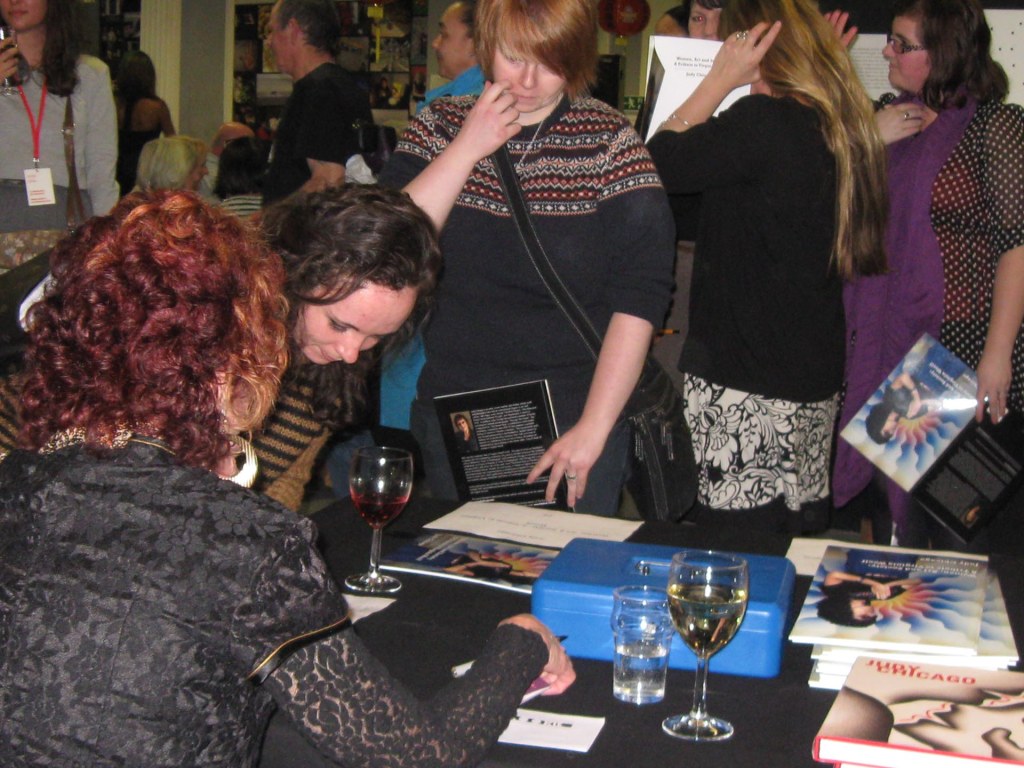
It was in this very appropriate setting, filled with Judy Chicago fans, that the launch of ‘Women, Art and Society: A Tribute to Virginia Woolf’ took place. Many people of all ages had arrived and packed into the gallery, some having to stand due to limited space, and availed of the buffet spread and free wine. The atmosphere was warm and sociable as visitors explored Judy’s exhibition ‘Voices, from the Song of Songs’, chatted and queued to have their copy of the Virginia Woolf lecture signed by Judy who graciously took time to speak to each person.
The Liverpool Biennial Artistic Director Sally Talent, Liverpool City Council’s Claire Glare and The Black-E’s Deputy Chair Wendy Harpe all gave speeches on how inspiring Judy’s work had been to them and how women’s struggles have improved since she gave the lecture, but also how we still have a long way to go. The evening was extremely successful and allowed younger artists the opportunity to network and speak to an inspirational artist who had succeeded in her practice.
I was lucky enough to have the chance to spend the following day with Judy and her husband, photographer Donald Woodman. A small group from The Black-E staff along with Sally Talent and Margaret Connell, owner of The Lantern Theatre took a mini bus tour around the Liverpool Biennial. It was an experience I am not going to forget anytime soon. Judy is a very honest and opinionated woman with a penchant for sequined blouses, and Donald with his painted blue nails, didn’t look like your average American tourists. We started at The Bluecoat to see the documentary film spilt across 3 screens on the life of Stuart Hall, which I found fascinating. The British cultural references and history were lost on Judy and she didn’t mind telling us as much. As we walked back to the mini bus we passed a small vintage shop and despite being on a tight time schedule to ensure Judy and Donald didn’t miss their train to London in the afternoon Judy insisted we go in.
The young woman running the shop seemed a little baffled by the make-up of our group; Bill a man in his mid 70’s dressed in a huge coat, trademark Russian hat and beard with ponytail, 2 middle aged working class Liverpool ladies, 1 very stressed looking middle class woman, 1 20-something Northern Irish woman and myself, a film-maker/crafter/PA in her late-20s, all piled into a tiny unit with our American friends; we certainly seemed to fit the 2012 Biennial theme of ‘Unexpected Guest’.
Judy tried on a couple of sequined tops over her own and with Donald’s assistance she quizzed the shop owner of their origin; turns out they were from America. We were all asked our opinion and I began to wonder if we were on a cultural trip or an average Liverpool ladies shopping day out. Judy decided on a particularly colourful blouse and obviously used to haggling the couple proceeded to get the best price for the top, despite the shop owner’s assertion that the price on the tag was the best price available. Although, even she wasn’t going to tell Judy Chicago she couldn’t have her own way.
After our detour we arrived at the Cunard building which housed a large collection of works for the Biennial. Judy particularly liked ‘Superflex’, a display of ‘for sale’ and ‘to let’ signs made by Liverpool artists to highlight the quantity of empty buildings in the city, including the vast cavernous space of the Cunard itself, which despite its dead space, is not currently being made best use of.
Our next stop was the Open Eye Gallery, now one of the premier photography galleries in Britain, where several exhibitions were taking place, including one which was also part of the gay arts festival Homotopia. Mark Morrisroe’s photograms and photo-collages were being exhibited some 23 years after his death from an AIDs related illness at the age of 30. Although a small selection, they were a poignant documentation of his final years when he used his hospital bathroom as a darkroom and incorporated X-rays of his declining body in the images.
While we were viewing the exhibition, a group of university art students came in and began taking photos of the entire show on their cameras and phones. Judy, irritated by the lack of true interaction they were having with the work, began to question why they weren’t looking at anything. They stated that they didn’t have time and would look back at it later but it was a clear reflection of the lack of engagement many people have with the arts in an over-saturated, readily consumable digital world.
From here, we made the short trip to the Tate to see the Doug Aitken exhibition, which Judy informed us in no uncertain terms was not to her taste so instead we opted for tea in the cafe and listened to Bill’s stories of his experiences working in the arts in Liverpool. Donald continued taking photographs of everything and everyone as he had done throughout the day, a practice no-one in our group blinked an eye at, now that we were all fully accustomed to the surreal field trip.
Our final destination was The Slavery Museum within the Maritime Museum where Judy and Donald were affected by the emotive video work in the museum of the slaves travelling on ships bound by shackles; they appreciated that it was simple yet effective and mentioned that they felt the subject matter in similar museums in America could often be underplayed so as not to offend visitors, rather than giving a true portrayal of events. As we were leaving, Donald spotted a coin pressing machine and Judy revealed that he collected pressed coins. He then spent the next 10 minutes pressing keepsakes to take home.
With somebody like Judy, it’s always obvious when she doesn’t like something because she’ll tell you she doesn’t, but it isn’t always easy to determine what she does like or rather, how much she likes a particular piece. She blows into town like a tornado with Donald in her wake, turns everything upside down and before you know it, is off to the next location. Despite various detours she and Donald made it to their London bound train, ready to start the cycle all over again in the Capital. She remains a dominant force among women artists and always has an opinion to give. In addition to The Black-E show and her exhibitions in London, she has a number of international shows on display and is always planning something new to follow.
More about Judy Chicago can be found at www.judychicago.com
More about The Black-E can be found at www.theblack-e.co.uk
NOTE: I am aware of the discourse and problematic nature of Judy Chicago and her work. I am of the mind that we should do our best and then when we know better, do better. Yes, there is a lack of diversity in ‘The Dinner Party’, however this work was made in the 1970s, before the internet and easy global communication. In saying this, I believe that even at the time more could have been done to include non white women as Judy Chicago and the women working on the piece could have reached out to various communities to find mythical and historical woman relevant to those communities. There are other problems in Chicago’s work including taking ownership of work done by other people for her participation works. I believe that if ‘The Dinner Party’ was made today, it would include woman from all over the world and the artists making the plates would get full credit for their participation. Read more here: https://hyperallergic.com/455572/judy-chicago-responds-to-criticisms-about-the-dinner-party/
 Amanda Jones Art and Design